
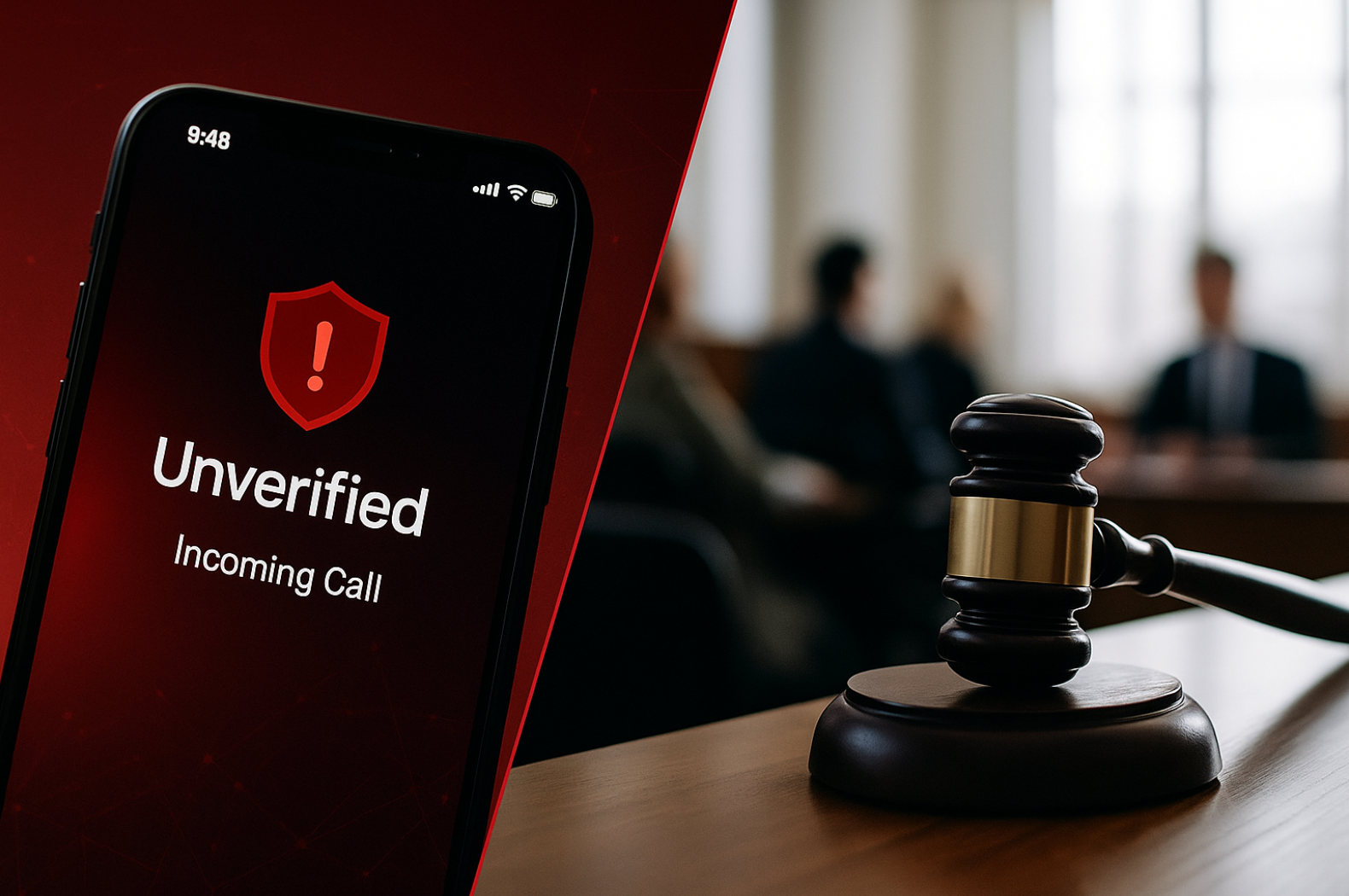
2025 was the year of enforcement. 2026 will be the year of example.
In 2025, regulators stopped warning and started acting. Across telecom, companies that once dismissed compliance as a formality began to face real consequences. Fines increased. Investigations expanded. Auditors no longer accepted claims without proof.
If your company treats call validation as a technical add-on, it’s time to rethink. Validation is now business protection. It defends your network, your clients, and your credibility. In 2026, regulators will use examples to make their point. You don’t want to be one.
2025: The year enforcement took hold
The last twelve months made the shift clear. Telecom regulators began linking negligence to accountability. They asked who allowed fraud to pass through a network, not who started it.
Industry data tells the story. Global telecom fraud losses hit roughly US $39 billion in 2023, a 12 percent rise from previous years, according to Globe Teleservices. Voice fraud remained one of the most expensive categories, with traffic pumping, robocalls, and CLI spoofing topping the list.
By 2025, regulators responded. The Federal Communications Commission (FCC) expanded investigations into robocall facilitators, warning carriers that failure to block or validate suspicious calls could result in network removal or fines. (FCC Enforcement Bureau)
In Europe, national telecom agencies under Ofcom took similar positions. Their 2025 guidance stated that every carrier in a call chain is accountable for ensuring call integrity, especially for international routes. (Ofcom UK Guidance)
This shift made 2025 a dividing line. The tolerance period ended. Regulators now expect proof that networks know what passes through them. The trend mirrors what 1Route explored in its blog on Silent Failures: that unseen weaknesses in call routing often surface only after enforcement catches up.
2026: The year of example
In 2026, regulators won’t just enforce—they’ll make examples. Penalties, settlements, and public notices will define new standards. Your competitors’ mistakes will teach others what happens when controls fail.
The smarter approach is to get ahead of that trend. Validation must evolve from a checkbox to a discipline. The goal is simple: demonstrate that your systems detect, verify, and stop fraudulent traffic before it damages customers or brand trust. This proactive mindset aligns with 1Route’s perspective in Why Validation is the Future of Fraud Prevention.
Here’s how you can build that defence.
1. Map your responsibilities and your exposure
You can’t manage what you haven’t defined. Create a full map of where you might face liability.
- Know your legal obligations. Review telecom, fraud, and data laws in every region you route traffic through. The International Telecommunication Union (ITU) maintains global references for anti-fraud frameworks and cross-border enforcement cooperation. (ITU Anti-Fraud Program)
- Audit your partners. List every routing partner, aggregator, and carrier you connect with. Record whether each has validation or attestation protocols in place.
- Track your exposure points. Identify inbound routes without proper verification, unknown aggregators, or regions where call origin data is incomplete.
- Assign ownership. Each compliance area must have a responsible person, measurable goal, and review date.
If you can’t name who monitors a route or regulation, you’ve already found a gap.
2. Validate your controls and prove they work
Policies are not protection unless you can show they function. Validation should be practical and evidence-based.
- Simulate failures. Pick one high-volume route and disable its automatic check for a brief test window. Track how quickly your monitoring system detects irregular traffic.
- Collect hard data. Keep logs that show timestamps, route sources, call counts, and validation outcomes.
- Measure performance. Record metrics such as “number of flagged calls,” “time to isolate fraud,” and “number of unverified partners.”
- Document remediation. When a call fails validation, document the investigation, action, and outcome.
Real examples show why this matters. In 2025, African carriers lost an estimated US $1.59 billion to mobile fraud, according to Connecting Africa. The majority involved interconnect chains where no single carrier validated the traffic. Validation closes that gap.
3. Build a risk-based validation program
Regulators no longer expect universal coverage. They expect smart prioritisation.
- Rank your risks. Identify which routes or partners carry the highest potential exposure. Focus testing and monitoring there first.
- Adjust resources. Invest heavier monitoring in high-risk zones and automate checks in lower-risk ones.
- Review often. Every new partnership, route, or market entry triggers a reassessment.
- Benchmark against peers. Compare your detection rates with sector averages shared by the Communications Fraud Control Association (CFCA). Their 2025 report ranked interconnect bypass and subscription fraud among the top global threats. (CFCA Report 2025)
A risk-based system makes compliance measurable. It also proves to regulators that your monitoring is intentional, not accidental.
4. Make validation a continuous process
One audit a year will not meet current expectations. Fraud patterns evolve weekly. Validation must be ongoing.
- Schedule regular reviews. Conduct monthly checks on key routes, quarterly audits of partner activity, and an annual third-party review.
- Create automatic alerts. Your network monitoring should flag spikes in call volume, route changes, or mismatched caller IDs.
- Track your metrics. Maintain a dashboard showing total calls reviewed, percentage validated, fraud attempts blocked, and average time to resolution.
- Report upstream. Share the data internally so executives understand the financial and regulatory value of validation.
The OECD Regulatory Policy Outlook 2025 confirmed that risk-based and data-driven monitoring has become the enforcement standard. (OECD Report) Carriers that can produce continuous validation records are better protected during audits.
5. Build awareness inside your company
Compliance cannot live in a single department. Fraud prevention requires coordination between network, legal, sales, and customer teams.
- Educate your staff. Everyone who handles routing or interconnect agreements must understand how unverified traffic can expose the company to penalties.
- Clarify escalation paths. Define who investigates a failed validation, who authorises route blocks, and who reports to regulators if needed.
- Train on new frameworks. Programs like STIR/SHAKEN, which authenticate caller identity, continue to expand globally. The FCC’s Robocall Mitigation Database requires carriers to file their compliance status. (FCC Robocall Mitigation)
- Use practical examples. Share anonymised cases within your team showing how a single missed validation created months of cleanup.
When your staff can explain validation in plain language, your network becomes stronger by default.This aligns with the principle 1Route outlined in Shared Networks, Shared Responsibility: one weak link can compromise everyone in the chain.
The cost of inaction
Fraud may not originate in your network, but if it moves through it, you are accountable. In 2025, several carriers faced public exposure after fraudulent traffic was traced back to their systems. Regulators and enterprise clients no longer distinguish between intent and allowance.
A report by Telecom Review noted that reputation loss often outweighs the fine itself. Providers that failed to block scam calls saw client churn within weeks of public disclosure. (Telecom Review Global 2025)
The pattern is simple. Doing nothing costs more than prevention. You can spend a few thousand validating routes, or hundreds of thousands repairing damage after fraud is exposed.
Practical steps for 2026
Here’s a concrete plan for the next quarter:
- Create your regulation log. List every regional or international rule that applies to your network. Include anti-fraud, data privacy, and call authentication laws.
- Audit your partners. Confirm that every carrier, aggregator, or vendor in your routing chain performs call validation or attestation.
- Run a validation test. Pick one route, introduce a known invalid pattern, and measure how quickly your system detects and responds.
- Record your findings. Document response times, blocks, alerts, and costs avoided.
- Present results. Report them to leadership in plain numbers. Tie fraud prevention directly to operational savings.
- Repeat. Set a monthly cycle. Consistency proves diligence.
When you can produce data showing continuous testing and improvement, you control the narrative during audits or inquiries.
Why this shift matters
The telecom ecosystem is interconnected. A weak validation point affects everyone. Fraud travels through shared channels faster than any single company can trace. That’s why accountability is now distributed.
The European Telecommunications Standards Institute (ETSI) described it plainly: “Shared networks require shared security responsibility.” (ETSI Fraud Management Report 2025)
For businesses, this means liability no longer ends at your border. It extends to every call you route, every partner you engage, and every record you fail to verify. Treating validation as optional is no longer realistic.
A new standard of proof
In 2026, telecom enforcement will resemble financial compliance. Regulators will expect traceable, time-stamped proof that your systems work. Screenshots and policy binders will not suffice.
To meet that standard, you need:
- Logs that show validation events and timestamps.
- Data linking call origins, terminations, and attestation levels.
- Written procedures showing who acted and when.
- Evidence of continuous review and correction.
These elements together form your defence. They demonstrate awareness, readiness, and responsibility.
Looking ahead
Enforcement is now routine. The next phase is demonstration. Carriers that can demonstrate active validation and control will set the benchmark for the rest of the industry. Those who wait for enforcement letters will spend 2026 explaining what went wrong.
The simplest strategy is to start now. Choose one inbound route. Run a test. Record what happens. Build on it weekly. Over time, you will build an auditable record of validation that protects you from both fraud and regulatory exposure.
That’s the difference between being an example of compliance and an example of failure.
