

Deepfake Dialers: How AI Voice Cloning Is Breaking Caller Trust in 2026
Voice used to be the final layer of trust.
If a call sounded right, most systems and most people treated it as real. That assumption powered everything from executive approvals to bank verifications to customer service workflows. It made sense in a world where voices were difficult to imitate.
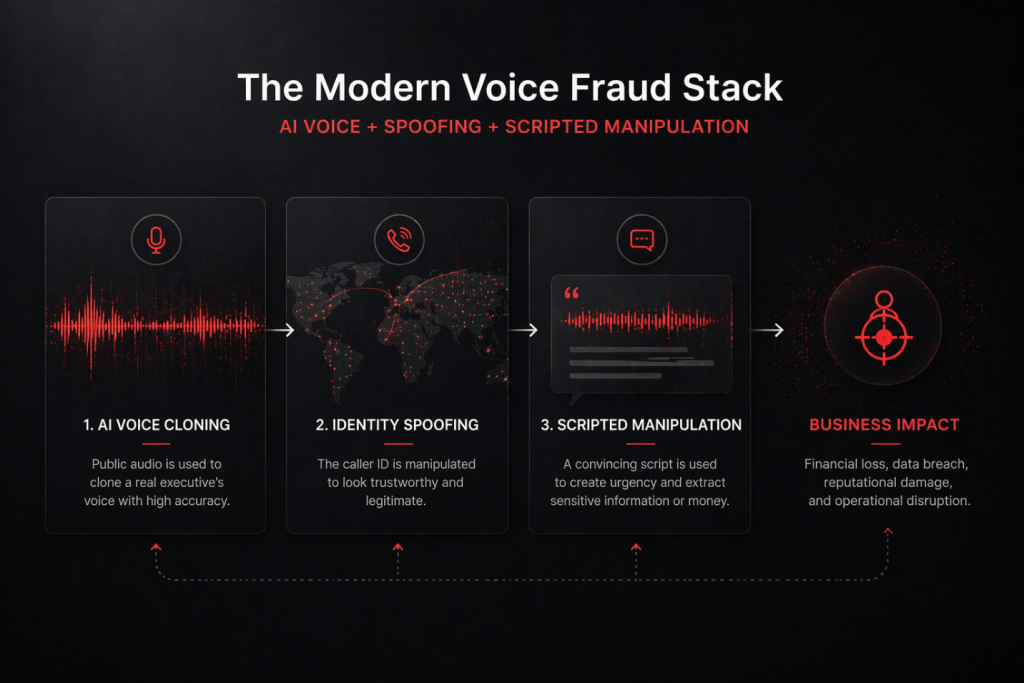
AI voice impersonation attacks have crossed a threshold where “sounding real” is no longer reliable. Real-time voice cloning, paired with caller ID spoofing attacks and social engineering tactics, has turned the phone call into one of the most effective attack vectors in the modern fraud stack.
Here’s the problem most organizations haven’t fully processed yet: the next major fraud incident may not look suspicious. It may look routine. It may pass internal checks. It may sound familiar.
And when the money moves, the account changes, or the credential reset goes through, the real question will not be why the victim trusted the call.
It will be why the system did.
Key Takeaways for Decision-Makers
- AI voice phishing now combines cloned voices, spoofed numbers, and adaptive scripts into highly convincing fraud operations.
- Caller identity and voice familiarity are no longer enough to verify trust in high-risk workflows.
- Enterprise vishing attacks increasingly target wire transfers, credential resets, vendor payments, and internal approvals inside large organizations.
- Human verification fails when synthetic media threats sound calm, familiar, and contextually correct under pressure.
- Behavioral detection and telephony metadata analysis provide stronger risk signals than voice identity alone can offer.
How Did AI Voice Impersonation Attacks Get This Good?
AI voice fraud did not evolve gradually. It snapped into place.
From Niche Tech to Commodity Tool
Voice synthesis technology used to live in labs and high-budget production environments. Today, it is widely available through consumer-facing tools and underground marketplaces. Organizations like McAfee and Consumer Reports have documented how little source audio is needed to generate convincing synthetic speech.
Three seconds of audio may be enough. That is a business opportunity for attackers.
The raw material is everywhere. Executives speak on podcasts. Sales leaders host webinars. Founders publish video updates. Every public clip becomes potential training data.
The New Fraud Stack
Modern vishing attacks combine multiple layers into a single operation:
- Real-time voice cloning trained on publicly available audio
- Caller ID spoofing to reinforce perceived legitimacy
- AI-generated scripts that adapt during the conversation
- Personal data scraped from social and corporate sources
This stack transforms fraud into a repeatable system. Attackers test scripts, refine timing, measure success, and scale what works.
What Do Real AI Voice Phishing Attacks Look Like in 2026?
The attack patterns are already established, and they are scaling fast.
Executive Impersonation and Wire Fraud
AI-generated wire transfer fraud remains one of the most direct applications. Attackers clone the voice of a senior executive and contact employees with financial authority. The request is urgent, contextual, and consistent with real business behavior.
The call may reference a confidential acquisition, vendor dispute, delayed invoice, or board-level request. The details only need to be plausible enough to push the employee into motion.
Fraudulent Bank Agent Calls
Fraudulent bank agent calls target consumers, especially elderly victims. The synthetic caller presents as a fraud prevention representative, warning of suspicious activity and guiding the target through “verification” steps.
The tone is not aggressive. It is reassuring, procedural, and professional.
Human Verification Bypass
This is where the architecture breaks.
If a process depends on a human listening to a voice and confirming it “sounds right,” AI can pass that check. The voice only needs to be convincing under pressure.
Enterprise Vishing Attacks
Enterprise vishing attacks focus on internal systems. Attackers impersonate employees, IT staff, vendors, or executives to reset credentials, reroute payments, or push unauthorized changes.
According to CrowdStrike’s 2025 Global Threat Report, voice-based social engineering has surged as attackers prioritize access over noise. The objective is not always immediate theft. Sometimes it is entry.
Why Caller Identity Fails Against Synthetic Voices
Caller identity fails because it is too easy to replicate.
A spoofed number, a cloned voice, and a well-timed request create a call that looks and sounds legitimate. That combination is enough to bypass many safeguards, especially in organizations that reward speed over scrutiny.
Identity-Based Trust vs Behavioral Trust
Identity-based trust asks whether a call appears to come from the right source. Behavioral trust asks whether the call behaves like legitimate traffic.
That distinction is becoming critical because identity signals can now be manufactured at scale. Caller ID can be spoofed. Voices can be cloned. Context can be scraped.
Behavior is harder to counterfeit consistently across the full call journey. Routing paths, origination patterns, timing, and call velocity create richer signals than voice alone.
Regulatory Context
Regulators are responding. The FCC’s ruling on AI-generated voices classifies them as artificial under existing robocall laws, and agencies like the FTC continue to expand enforcement efforts against fraud.
That matters—but enforcement happens after the fact. Fraud prevention requires real-time insight into call behavior.
5 Practical Ways to Reduce Risk from AI Voice Phishing Attacks
1. Remove Voice-Only Approval Workflows
Critical actions such as wire transfers, vendor payment changes, and credential resets should never rely solely on a phone call. If a cloned voice can authorize a transaction, the workflow has already handed the attacker a red carpet.
2. Enforce Independent Call-Back Protocols
Verification must occur through known channels. Calling back the same number is not verification—it is repetition with better manners.
Use approved directories, internal messaging systems, or pre-established escalation paths.
3. Train for Behavioral Red Flags
Employees should be trained to identify patterns, not just tone:
- Unusual urgency or secrecy
- Requests that bypass standard workflows
- Timing that falls outside normal operations
- Payment destinations that deviate from established patterns
- Pressure to avoid written confirmation
Employees need clear decision rules they can apply under pressure.
4. Monitor Calls at the Network Level
Real-time call monitoring and telephony metadata analysis provide visibility beyond human perception. Routing paths, origination patterns, call velocity, and repeated targeting behavior reveal signals that audio alone cannot.
Many AI voice phishing attacks are part of campaigns. One call may sound normal. The broader pattern may look radioactive.
5. Combine Audio and Behavioral Detection
Voice clone detection software can help identify synthetic audio, but it should be paired with behavioral biometrics and network-level analysis. The goal is layered defense—not blind reliance on one heroic tool.
Audio detection asks whether the voice sounds artificial. Behavioral detection asks whether the call behaves like it belongs.
Where Behavioral Detection Changes the Game
The most effective response to AI voice fraud is not teaching humans to distrust every call. That approach breaks communication faster than it stops fraud.
The better approach is shifting validation earlier in the call lifecycle.
Behavioral detection evaluates how a call behaves across its journey, not just how it sounds at the endpoint. It analyzes routing, timing, origination, handoffs, and interaction sequences, giving operators a better chance of distinguishing legitimate traffic from synthetic manipulation.
This is where platforms like 1Route operate.
1Route validates calls at the network level, combining call validation, real-time call monitoring, and fraud detection to identify suspicious behavior before the call reaches its target. Its approach builds on insights from AI telecom fraud prevention and call validation.
Instead of relying on identity signals alone, 1Route analyzes where the call originated, how it was routed, and whether its signals suggest risk before a human ever says hello.
Why 2026 Is a Turning Point for Voice Trust
The cybersecurity threat landscape in 2026 is defined by one uncomfortable reality: synthetic media is now good enough to break old assumptions.
The traditional trust model assumed that identity could be verified at the edge. That assumption no longer holds.
The new model requires continuous validation across the call lifecycle, from origination to termination, supported by systems that interpret behavior in real time.
Carriers and enterprises do not need to make every person suspicious of every voice. They need infrastructure that can separate legitimate communication from manipulated traffic earlier.
FAQ: AI Voice Phishing and Call Validation
Can AI really clone someone’s voice convincingly?
Yes. Modern tools can generate realistic voices from minimal audio samples, especially when the target has public recordings online. The clone does not need studio perfection. It only needs enough familiarity, context, and urgency to make the listener hesitate before questioning it.
What makes vishing attacks in 2026 different?
These attacks combine voice cloning, AI-generated scripts, caller ID spoofing, and real-time adaptation. Traditional vishing relied on pressure and persuasion. Modern AI voice phishing adds synthetic familiarity, making the call feel less like a scam and more like routine business communication.
Can caller ID authentication stop these attacks?
Caller authentication helps, but it does not detect synthetic voices or suspicious behavior across the network. It can verify certain identity signals, but AI voice fraud often exploits the gap between a call appearing legitimate and a call actually behaving legitimately.
What is human verification bypass?
Human verification bypass happens when an AI-generated voice passes a manual review process that relies on listening and judgment. If the reviewer hears a familiar voice, receives plausible context, and feels urgency, the attacker can move through the checkpoint before scrutiny catches up.
How can organizations reduce AI-enabled financial fraud?
Organizations should remove voice-only approvals, enforce independent call-back protocols, train employees on behavioral red flags, and monitor calls at the network level. The strongest defense combines human process discipline with real-time behavioral detection, telephony metadata analysis, and clear escalation rules.
Why is behavioral trust more effective?
Behavioral trust evaluates patterns that are harder to fake consistently, including routing, timing, origination, velocity, and interaction behavior. Voices and caller IDs can be manufactured, but a suspicious call journey often leaves network-level signals that identity-based checks can routinely miss.
Trust Isn’t Gone. It’s Just in the Wrong Place.
A familiar voice used to be enough. Now it is just another data point, one that can be copied, scaled, and deployed on demand. Systems that continue to treat it as proof will fail in predictable ways.
The systems that adapt—that validate behavior, analyze call journeys, and operate with real-time awareness—will define the next phase of trusted communication.
Deepfake dialers did not destroy trust. They exposed where it was weakest.
The only question now is whether your network knows the difference.
Ready to see how 1Route helps bring trust back to voice? Talk to the 1Route team today.
