

AI Telecom Fraud Prevention: Who’s Really Winning the Fight?
Picture this: a wire transfer request comes in over a voice call. It sounds exactly like your CEO—the breathing, the pauses, the “ums” between sentences. You approve it. Later, you find out your CEO never made that call.
This is not a hypothetical. This is generative AI telecom fraud in 2026, and it is already happening to businesses like yours.
As noted by Forbes: “The global infrastructure is evolving faster than ever, driven by AI, quantum computing, and the Internet of Things.”
Fraudsters, it turns out, got the memo. Unwanted traffic continues to challenge operators, with spam, robo, and phishing calls reported by over 53% of carriers—and the tactics behind them are getting smarter by the month.
The global telecom fraud landscape is now a full-scale artificial intelligence arms race, fought call by call across every network on the planet.
At 1Route, our mission is straightforward: bringing trust back to voice. In 2026, that mission has never mattered more.
Key Takeaways (TL;DR): AI Is Fighting AI
- The threat is smarter than ever. Generative AI gives fraudsters cloned voices, adaptive scam scripts, and multilingual campaigns at unprecedented scale.
- The industry is fighting back. Three-quarters of telecom decision makers now use machine learning or AI for fraud detection, up sharply from 2023.
- Traditional tools are struggling. The Indistinguishable Threshold has been crossed. Only adaptive AI defense moves fast enough to match the threat.
- Architecture beats tools. Real-time call validation and cross-network intelligence sharing are the foundation of digital trust in voice communications.
- The stakes are climbing. Projected fraud losses are tracking toward $15.6 billion in 2025. Standing still is not a strategy.
How Generative AI Is Supercharging Telecom Scams
Fraudsters are no longer just spoofing numbers.
Today, they are deploying large language models to write hyper-personalized scam scripts, cloning voices from social media audio, and running multilingual fraud campaigns at scale. What used to require a warehouse of hackers now only requires a laptop and a decent Wi-Fi connection. The tools are cheap, accessible, and terrifyingly effective.
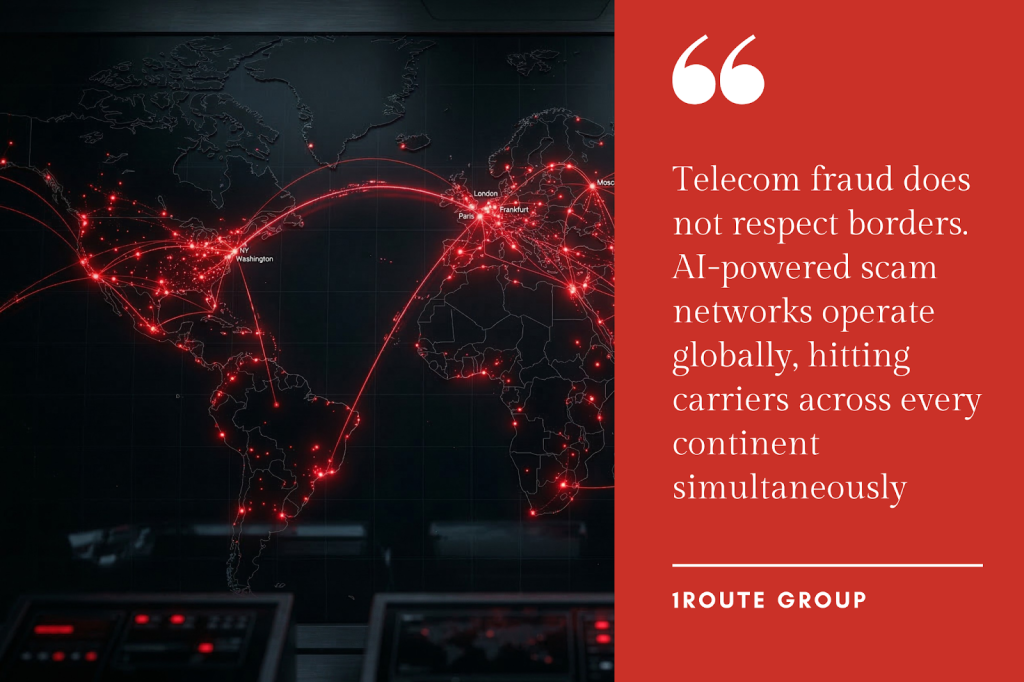
The fraud playbook looks something like this:
- Spoofed phone calls with cloned voices: Real-sounding audio generated from as little as three seconds of source material, used to impersonate executives, family members, and government officials.
- Voice cloning scams: AI-guided calls that adapt in real time to a victim’s responses, steering conversations toward financial transactions.
- The vishing (voice phishing) blind spot: Traditional detection tools were built for pattern recognition. They were never designed for conversations that pass the human test.
Industry leaders are taking note of exactly this shift.
“Collaboration, vigilance, and proactive measures are essential to secure a trusted telecom ecosystem,” says Eloy Rodriguez, Chief Wholesale Officer at Telefonica Global Solutions. “Operators must continue investing in fraud prevention and leveraging innovative tools to stay ahead of increasingly sophisticated schemes.”
The barrier to entry for telecom fraud has never been lower, and the ceiling for damage has never been higher.
Why AI Makes Fraud Harder to Detect Than Ever Before
The uncomfortable truth about modern telecom fraud is that the problem is no longer volume. It is credibility.
AI-generated voices blur the line between real and fake calls. Automation multiplies scam volume overnight. And traditional detection tools—built to flag anomalies in telecom traffic patterns—were simply not designed to interrogate the content and behavior of a call in real time.
Relying solely on digital signatures today feels a bit like airport security in the 90s. We are all dutifully taking our shoes off and throwing away our water bottles while the bad guys are literally using a teleporter to get to the gate.
To be fair, the industry is not standing still. Three-quarters of telecom decision makers now use machine learning or AI for fraud detection. That is encouraging. The challenge is that fraudulent traffic pumping, manipulated routing intelligence, and synthetic voice attacks are keeping pace. In some cases, they are pulling ahead.
When the threat learns as quickly as the defense, standing still is not an option.
When the Defenders Fight Back: How Telecom Operators Use AI
Telecom operators are not just watching the threat evolve. They are deploying more capable tools, building shared intelligence networks, and making life considerably harder for the bad guys.
The Consortium Effect: Shared Intelligence at Scale
No single carrier sees the full picture, and that is exactly what global fraud rings count on. The industry’s answer is pooling anomaly detection data and traffic intelligence across carriers and borders. When one network spots a new fraud pattern, every connected network benefits.
Deep Content Inspection Is Changing the Game
Juniper Research predicts consumer losses to messaging fraud will fall 10% in 2026, crediting enhanced firewall capabilities that make it harder for fraudulent actors to bypass detection systems. Fraud detection algorithms are finally catching up to the content layer, where AI-generated deception actually lives.
Explainable AI: Knowing Why, Not Just What
Legacy systems flagged suspicious calls without explaining why. Modern fraud analytics platforms built on explainable AI show operators exactly which signals triggered a flag, making it faster to act and simpler to explain to regulators.
The defenders are catching up, and the fraudsters are running out of easy wins.
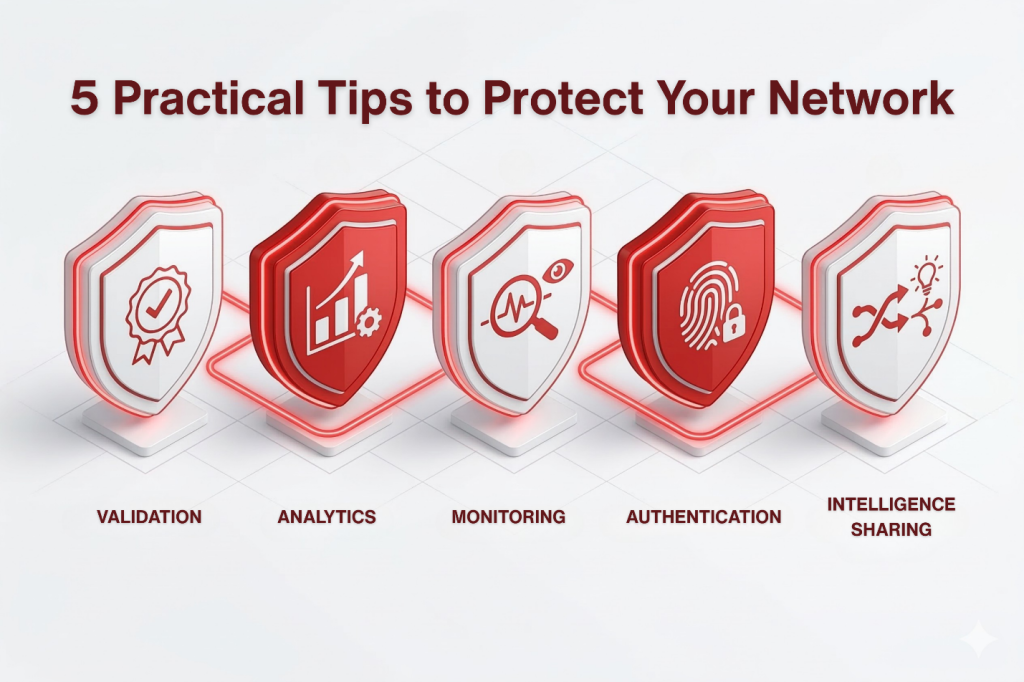
5 Practical Ways Telecom Providers Can Stay Ahead of AI-Powered Fraud
Catching up, though, is only half the battle. The other half is knowing exactly where to focus.
Here’s something the industry does not say enough: most networks are not failing because they lack tools. They are failing because their tools are not talking to each other.
Call it the Siloed Defense Problem. Operators invest in endpoint solutions, authentication layers, and identity verification systems independently, then wonder why coordinated fraud slips through the gaps. The fix isn’t more tools, but better architecture.
In practice, that means:
- Deploying real-time call validation: Catch fraudulent traffic before it completes its journey, not after the damage is done.
- Adopting AI voice cloning mitigation at the network level: Endpoint detection alone is too slow. The network has to be part of the defense.
- Monitoring traffic patterns across carriers: Fraud does not respect network boundaries. Your detection strategy should not either.
- Combining authentication frameworks with AI detection: STIR/SHAKEN is the foundation, not the finish line.
- Investing in cross-network intelligence sharing: The Siloed Defense Problem only gets solved when operators stop treating shared data as a competitive liability.
Smarter architecture beats more tools, every single time.

Where 1Route Fits in the Fight Against AI-Driven Telecom Fraud
Have you ever received a call so convincing you almost didn’t question it? You’re not alone.
The Wall Street Journal put it plainly: “With AI as an accomplice, fraudsters are reaping more money from victims of all ages.” In 2024, the FTC reported $12.5 billion in fraud losses. With losses growing 25% year over year, 2025 projections are tracking toward $15.6 billion.
1Route sits at the exact layer of the network where fraudulent calls are born, routed, and delivered. As a global call clearinghouse, we validate calls before they reach their destination. That shows up in three concrete ways:
- AB handshake verification: Authenticating the exchange between originating and terminating service providers to confirm a call is exactly what it claims to be.
- Real-time traffic analysis: Spotting anomalies in call patterns before fraud completes its journey.
- Cross-network visibility: Monitoring traffic globally, because fraudsters certainly aren’t staying in one lane.
What Makes 1Route Different in a Crowded Telecom Security Landscape
In a landscape full of point solutions, 1Route is built for the whole network.
Most platforms guard the edges. 1Route operates at the core, eliminating blind spots from within the routing core. Think of it this way: a carrier in Southeast Asia routes a spoofed call through three intermediaries before it hits a US network. Traditional tools see the last hop. 1Route sees the journey.
Key differentiators include:
- Routing blind spots across carrier networks: 1Route maps the full call journey through global traffic intelligence, closing the gaps that local snapshots miss.
- Telecom regulatory frameworks: Supported across regions, so compliance travels with the call.
- STIR/SHAKEN compatibility: 1Route complements existing authentication standards rather than duplicating them.
FAQ: AI, Telecom Fraud, and Call Validation
Can AI really clone someone’s voice convincingly?
Yes, and it only needs about three seconds of audio to do it. Welcome to 2026.
How are telecom providers detecting AI-generated scams?
Scam call detection now relies on behavioral pattern analysis, traffic anomaly monitoring, and real-time call validation across carrier networks.
Does STIR/SHAKEN stop AI fraud?
It authenticates caller identity, but it was not built for AI-generated content. Think of it as a lock on the front door of a house with open windows.
What is call validation and how does it work?
It analyzes a call’s full routing path, verifying each handoff between carriers before the call reaches its destination.
Can reducing fraud also improve customer experience?
Absolutely. Fewer scam calls means lower average hold time, less misdirected traffic, and more trust in every call that does come through.
The Future of Voice Depends on Who Uses AI Better
As of late 2025, the industry officially crossed what researchers call the “Indistinguishable Threshold” or the point where AI-generated voices became impossible to distinguish from real ones by the human ear alone. AI got us here. AI is also the only way out.
The arms race is accelerating. Fraud networks are scaling. The stakes are climbing. At this rate, by 2027, our phones will just be two AIs arguing over a fake invoice while we finally get to enjoy a silent dinner. Until then, your network needs intelligence that moves faster than the threat.
AI got us into this fight. AI—the right AI—wins it.
The future of voice security belongs to whoever deploys AI smarter, faster, and at greater scale. Ready to see where 1Route fits in your fraud prevention stack? Let’s talk.
