
SIM Swap Fraud Prevention for Mobile Money: Why the GSMA SIM Swap API Isn’t Enough
In 1991, Munich smart-card maker Giesecke+Devrient delivered the first commercial SIM card to Radiolinja, the Finnish operator behind the world’s first GSM network. The chip had one job: prove to the network that a phone belonged to a paying subscriber. Thirty-five years later, the same chip sits behind bank accounts, mobile wallets and government services across Europe, Africa, Latin America and Asia.
What changed along the way is where the proof lives. Most mobile money platforms no longer ask the chip who you are. They send a one-time passcode by SMS, and an SMS goes to whichever SIM the operator has linked to the number. Persuade the operator to move the number to a new SIM, and the passcodes follow.
That gap is a daily problem for fraud, risk and product teams at mobile network operators and mobile money providers. SIM swap fraud in mobile money can empty an account before anyone notices the old SIM has gone quiet. 1Route’s On-SIM protection returns the proof to the chip, so a hijacked number stops being useful to the person who took it. The industry’s best-known answer so far works differently.
What the GSMA SIM Swap API Does, and What It Doesn’t
That answer is the GSMA SIM Swap API. Built on the open-source CAMARA project, it lets a bank ask an operator one question about a phone number: has its SIM changed recently? A check call returns yes or no for a chosen window, such as the last 24 hours, and a retrieve-date call returns the time of the most recent swap.
With that answer in hand, a bank can decline a payment when a swap is fresh. That was the purpose when South African operators Cell C, MTN and Telkom launched it in February 2024. Used this way, the API turns the operator’s own records into a signal any bank can query.
The signal arrives after the event, though. By the time the API reports a swap, the operator has already issued the new SIM, and the fraudster is already receiving the victim’s SMS codes. Whether that report stops a loss depends on every bank and wallet integrating the check, choosing a sensible window and calling it before money moves.
That is the core SIM swap API limitation: the protection lives in other people’s systems, and it works only if each of them acts in time. So where else, between swap and payment, can the fraud be caught?

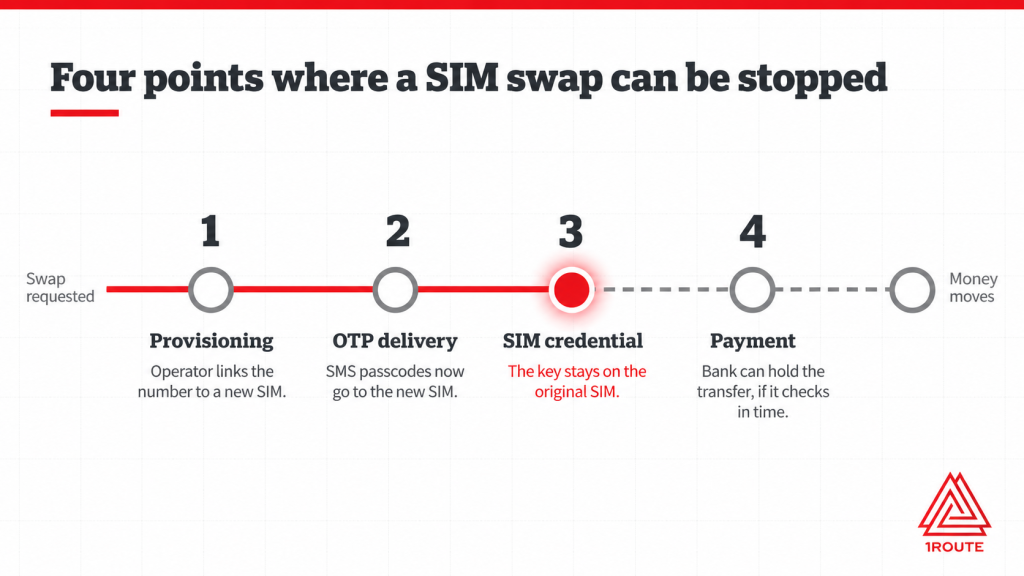
Where a SIM Swap Can Be Stopped: Four Control Points
At 3:40 on a weekday afternoon, a market trader in Johannesburg sees “No service” on her phone and assumes the network is down. Across town, a new SIM carrying her number has just come online, and the first one-time passcode is already on its way to it.
Her afternoon repeats across South Africa. The Communication Risk Information Centre (COMRiC) links nearly 60% of mobile banking fraud to SIM swaps, part of an estimated R5.3 billion a year in telecom-linked fraud. Yet only 3% of the roughly 3,600 swap requests operators processed in early 2025 proved fraudulent. Catching that 3% leaves four places to look.
1. Provisioning
The first is the moment the operator approves the request and links the number to the new SIM in its subscriber database. Identity checks stop crude attempts, while forged documents and telco insider threats, such as a retail agent paid to look away, slip through. The details that make a request convincing often come from phishing texts, traded through a wider telecom fraud supply chain.
2. OTP Delivery
Once a request gets through, every SMS passcode flows to the new SIM. SMS OTP interception needs no hacking at this stage, because the network delivers the code exactly as designed.
3. The SIM Credential
The third point sits on the original SIM. A secret stored on the chip doesn’t move with the number, so when the wallet asks for that secret, the swapped SIM has nothing to answer with.
4. The Payment
The last chance falls to the bank or wallet, which can hold a transfer after a recent swap if the check runs before money moves.
Points one, two and four depend on people, integrations and timing all working at once. Point three depends only on the chip.
How SIM-Based Authentication Makes a Swapped SIM Useless
Depending on the chip is the idea behind SIM-based authentication, which moves the proof of identity off the SMS channel and onto the SIM. A SIM is a small secure computer, able to run a SIM applet: a compact program that holds a secret key no one can read or copy out.
When a payment needs approval, the server sends the applet a challenge, and the applet signs it with that key. A replacement SIM issued to a fraudster has no enrolled key, so the challenge goes unanswered. The number moved; the identity stayed behind.
Because the applet lives on the SIM rather than in an app, it also reaches customers that app-based tools miss. Many mobile money users carry feature phones that can’t run authenticator apps or passkeys. But their SIMs can still run an applet, and the SIM Toolkit menus their wallets already use can carry its prompts.
Re-enrollment needs the same care. If a customer who loses a SIM can bind a new one with only an SMS code, so can a fraudster, which makes mobile money identity verification at that step part of the design. That design is the one 1Route builds on.
How 1Route On-SIM Neutralizes SIM Swap Fraud in Real Time
1Route’s On-SIM protection applies SIM-based authentication to mobile money and digital identity, pairing an applet on the subscriber’s SIM or eSIM with a cloud platform that runs the fraud rules.
A Digital ID a New SIM Can’t Inherit
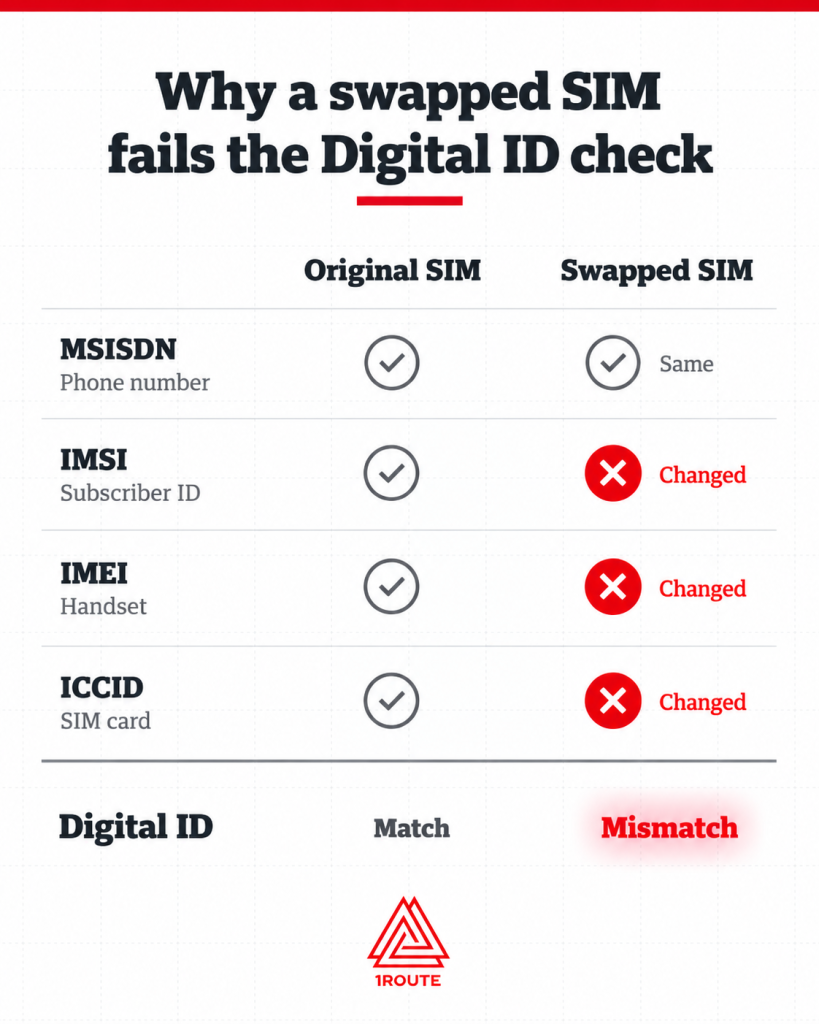
The applet binds four identifiers into one encrypted Digital ID: the phone number (MSISDN), the subscriber identity stored on the SIM (IMSI, or International Mobile Subscriber Identity), the handset (IMEI) and the card itself (ICCID). A swap changes the IMSI and ICCID, so the Digital ID stops matching.
Checks That Run All Session
A single check at login leaves the rest of the session open. On-SIM keeps validating the SIM, handset, location and behavior for the whole session, over background channels the subscriber never sees. That continuity is what separates it from SMS-based two-factor authentication.
Rules That Act in the Moment
Continuous checks pay off when something acts on them. When the platform’s Rule Engine spots a high-confidence fraud pattern, it can block the transaction, push a warning to a feature phone’s screen or end a call in progress. That is real-time SIM swap blocking at the point where money would move.
Alongside Open Gateway
On-SIM connects to billing, core network and mobile money platforms through REST APIs, across legacy TDM and modern SIP networks, without core infrastructure changes. The GSMA SIM Swap API tells a bank that a swap happened; On-SIM is built so the swapped number opens nothing. That is how 1Route pursues its mission of bringing trust back to subscribers, starting with the chip built to carry that trust in 1991.
Pago Móvil SIM Swap Fraud: Venezuela’s Bank-Linked Risk
Few countries ask the phone number to carry as much as Venezuela does. SUDEBAN, the banking regulator, began testing interbank Pago Móvil in October 2017 during a severe cash shortage. It links a bank account to a mobile number and lets customers pay by SMS.
The rules make that link explicit. Under SUDEBAN’s electronic banking rules (Resolution 641.10), the customer identifier for Pago Móvil is the mobile line number, which banks obtain automatically from the phone. A payment from the right number therefore looks legitimate by design.
That design concentrates risk. Customers often affiliate the same number with every bank they use, so one act of mobile number hijacking can open several accounts at once. Responsibility is split, too: the operator (Movilnet, Movistar or Digitel) controls the SIM, each bank controls its own authentication, and neither sees the whole picture.
Regulation covers both ends. CONATEL, the telecom regulator, requires operators to capture subscribers’ identity documents digitally (Providencia 171) and to register handset IMEIs so stolen phones can be blocked (Providencia 1869). The subscriber and the handset are both on record. The step in between, when a number moves to a new SIM, is where the fraudster works.
A SIM-level check covers that step from the operator’s side, so protection no longer hinges on every bank getting its own controls right. The same holds in African markets built on the same phone-centric model, and it suggests one test for any vendor.
Questions to Ask Any SIM Swap Prevention Vendor
Start with the first-transaction test: if a newly swapped SIM tried to move money one minute from now, would this control stop it? If the answer depends on someone reading a report, the control is detection. Then ask:
- Where does the decision happen: at provisioning, at login or at every transaction?
- What protects a customer on a feature phone with no app?
- How does a genuine customer re-enroll after losing a SIM, and what stops a fraudster from using the same path?
- How does the control map to the ITU-T X.1150 security framework, which treats operators, banks and mobile money providers as one ecosystem?
Frequently Asked Questions
Does the GSMA SIM Swap API block SIM swaps?
No. It reports whether, and when, a number’s SIM changed. A bank or wallet has to call it and act on the answer, for example by holding a payment after a recent swap.
Does SIM-based authentication work on feature phones?
Yes. The applet runs on the SIM, and its prompts appear through SIM Toolkit menus, so it doesn’t rely on a smartphone app. Handset support differs, which is why rollouts usually begin with a pilot on the operator’s own subscriber base.
How does SIM swap fraud affect Pago Móvil users?
Pago Móvil identifies customers by their mobile number. A fraudster who takes over that number receives the bank’s SMS codes and can reach the accounts linked to it.
The SIM was built in 1991 to prove who a subscriber was. Mobile money handed that job to a six-digit text message, and SIM swap fraud has lived in the gap ever since. Putting the credential back on the chip narrows that gap at its source.
Learning about a SIM swap from a status check is like a burglar alarm that rings once the thief already has the keys. Whether the money stays put depends on who’s listening, and how fast. Stopping the fraud before it pays off removes the guesswork.
If your team runs mobile money, or protects the subscribers who use it, talk to 1Route about putting proof of identity back on the SIM.
