
Think Before You Click: The Rise of SMS Phishing and the Texts That Are Emptying Bank Accounts
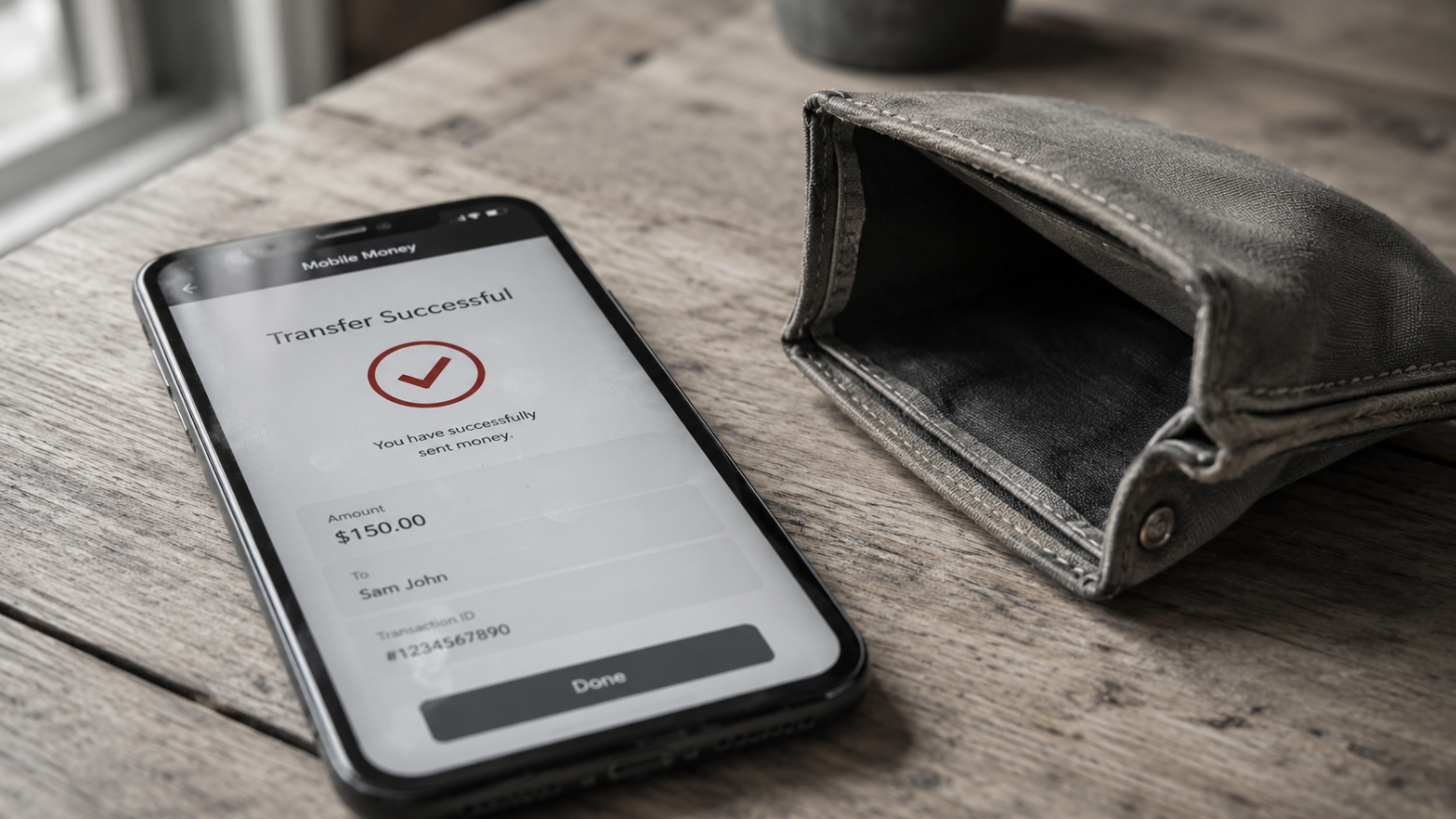
Mateo runs a small hardware shop in Manila. On a Tuesday morning in 2026, his phone buzzed with a text from his bank: unusual activity detected, tap here to secure your account. Same sender name he’d seen a hundred times before. Same blue checkmark logic he’d trained himself to trust. He tapped. Ninety seconds later, the account that paid his suppliers was empty, and the “bank” that texted him didn’t exist.
Mateo isn’t unusual. He’s the business model.
Smishing or SMS phishing is now one of the fastest-growing fraud types globally, and it starts with a single text that looks completely legitimate. It doesn’t need a hacker in a hoodie or a zero-day exploit. It needs a spoofed name, a sense of urgency, and about four seconds of your attention. That’s the whole attack surface.
What Is Smishing, and Why Is It Harder to Stop Than Email Phishing?
Smishing is phishing conducted over SMS. In practice, a fraudster sends a text designed to get you to click a link or hand over a code, engineered to look like it’s from a bank, delivery service, or government agency. The mechanism behind it is called sender ID spoofing: A scammer sets the display name on a message to match your bank, your delivery service, or your own mobile carrier, and your phone has no way to check if that’s true. It just displays it.
Ever wondered why your spam folder catches almost everything, while your texts arrive straight into the one inbox you actually trust? That gap comes down to architecture. Email built layers of defense over decades: spam filters, domain authentication, blocklists that update by the minute.
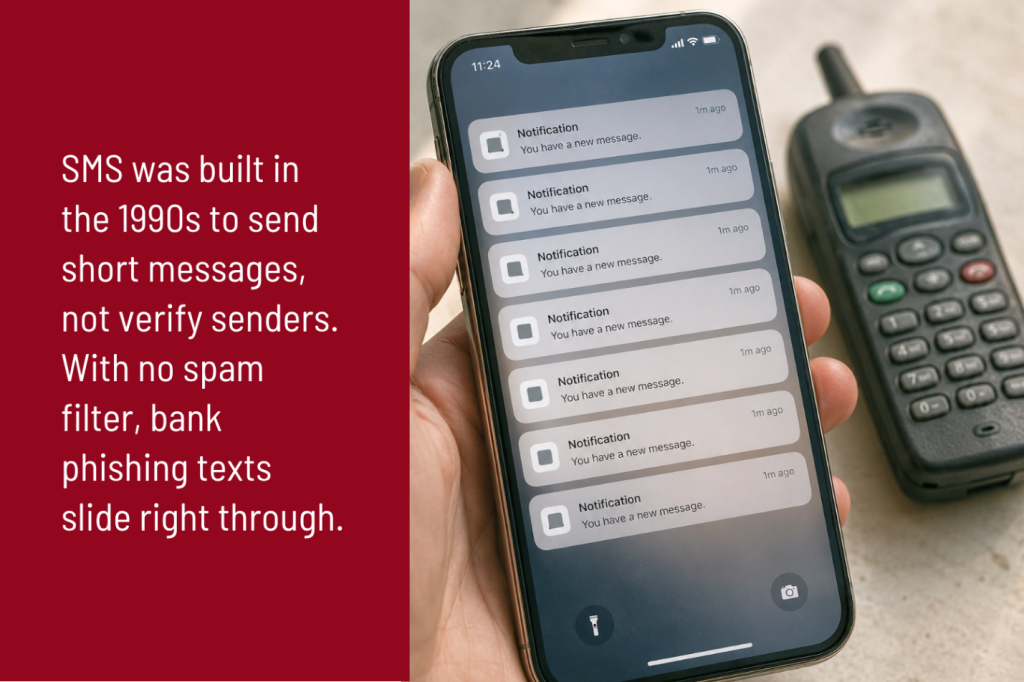
SMS was built in the 1990s to deliver 160 characters between phones, not to verify who sent them. There’s no equivalent of a spam folder standing between a fraudster and your notification screen, which is precisely why bank account phishing texts slide through untouched.
Combine that architecture gap with a message asking you to confirm a one-time password, and you have the two ingredients behind most OTP phishing scams: a message you trust, asking for the one code you shouldn’t share with anyone, ever, for any reason, from any “support agent” alive.
The Infrastructure Behind the Scam
Nobody types these messages out one at a time. Smishing runs on infrastructure built for scale: automated sending platforms, rotating phone numbers, and rented access to grey-route SMS traffic: messages routed through unofficial or unmonitored channels to dodge the fees and filters legitimate senders have to pay.
Some campaigns lean on SIM farm and SIM box activity, banks of active SIM cards used to blast thousands of near-identical texts before carriers can react. Others exploit SMS blaster devices, portable fake base stations that impersonate a cell tower and push messages directly to nearby phones, no carrier network involved at all.
Scale is the entire point.
These campaigns are timed, too—around salary disbursement dates, tax season, a widely reported network outage—because a fraudster who sends the right lie to the right person at the right moment can rely on volume alone. Send enough messages, and even a low hit rate turns a profit.
Why Does Mobile Money Fraud Hit Emerging Markets the Hardest?
The obvious answer is that emerging markets have weaker cybersecurity laws or less public awareness. That’s a comfortable theory. It’s also mostly wrong.
The real answer is simpler and harder to fix: in much of Africa, EMEA, and APAC, mobile money isn’t a convenience layered on top of a bank account. It is the bank account.
When a smishing text tricks someone into sharing an OTP, there’s no secondary savings account, no fraud department on hold music, no reversible transaction sitting in a queue. The money moves once, through a channel built for speed, and it’s gone.
Mobile money fraud hits hardest exactly where mobile money has done the most good. The same instant, low-friction rails that brought millions of people into the financial system are the ones fraudsters now ride to drain it.
SIM swapping compounds the problem. So does Wangiri-style number harvesting, which hands fraudsters a fresh list of active, reachable phones to target next. None of this is a knowledge gap. It’s an infrastructure gap, and it needs an infrastructure answer.
What Is the Industry Doing About It?
Regulators have noticed. Ofcom, the UK’s communications regulator, reported roughly 100 million suspicious messages flagged by mobile users in a single year and has proposed rules requiring providers to verify alphanumeric sender IDs against the businesses that claim them, block known scam numbers in transit, and run “Know Your Traffic” checks on bulk senders.
The European Union Agency for Cybersecurity has pushed similar sender-verification standards across EU member states. And global bodies including the GSMA and Mobile Ecosystem Forum maintain a sender ID registry: a shared record of who’s authorized to send under which business name, designed to strip fraudsters of the one thing they rely on most, a familiar name on the screen.
The direction is consistent across every one of these efforts:
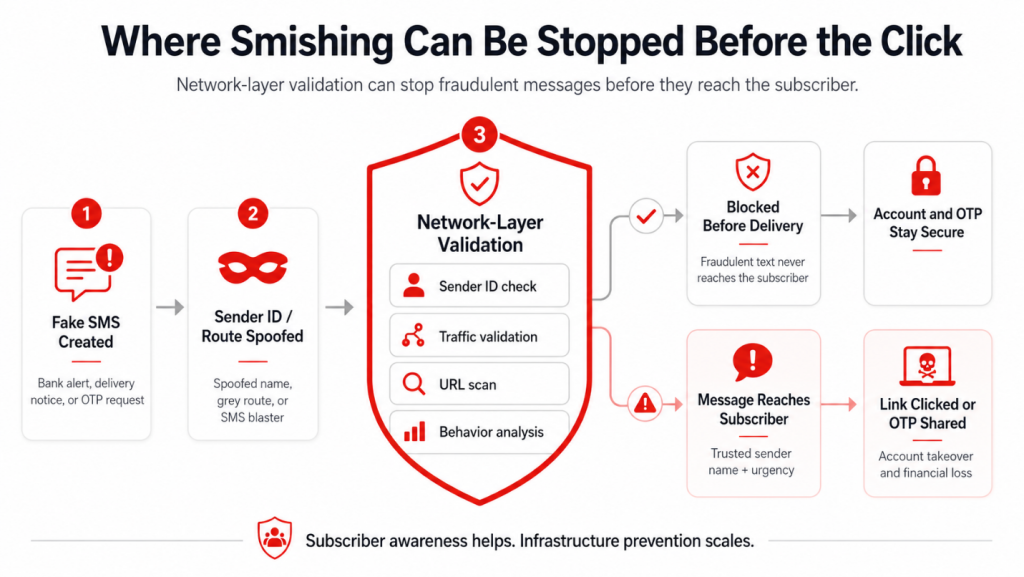
- Verify the sender before the message reaches a subscriber, not after a victim reports it
- Treat SMS the same way voice networks now treat calls, with identity checked at the source
- Share threat intelligence across operators and borders, since a campaign blocked in one country simply relaunches in the next
None of it works in isolation. Verified sender IDs, cross-border data sharing, and real-time blocking only add up to something when every regulator and carrier commits to the same standard at the same time.
How 1Route Stops Smishing Before the Click
A HackerNoon headline from earlier this year put it plainly: SMS blasters are the smishing scam to watch in 2026. Fraudsters don’t wait for permission, and neither should your defenses.
Most fraud tools still work like a claims adjuster: something bad happens, a report gets filed, someone reviews the damage weeks later, and the fraudster is three burner numbers away by then. 1Route was built to skip that entire sad routine.
Our FINIS Platform functions as an SMS firewall protection layer inside the core signaling network, screening sender behavior and blocking fraud patterns in real time instead of cataloguing them after the fact. Fraud doesn’t file a report and wait its turn, and neither do we.
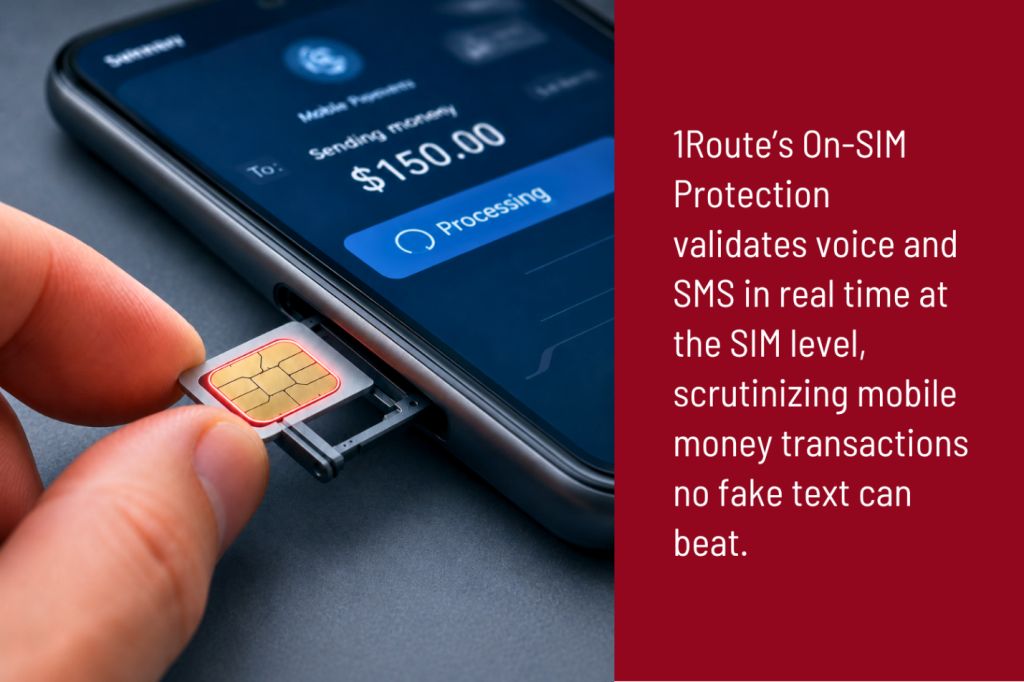
The subscriber layer carries the heaviest load, because it’s the last line standing between a spoofed message and a stolen OTP. 1Route’s On-SIM Protection applies fraud controls directly at the SIM level, validating voice and SMS activity in real time and giving mobile money transactions a layer of scrutiny that a text message alone can never fake its way past.
It’s the same throughline running through the fraud supply chain we’ve mapped out before: every scam, whether it rings or buzzes, ripples outward through the entire telecom ecosystem long before a single dollar goes missing.
Spoofers spoof. Scammers scale. Subscribers shouldn’t have to sort out which text is real at 11pm on a Tuesday—and with the right defense sitting at the network level, they don’t have to.
The Impact: Restoring Trust
Trust doesn’t come back with a press release.
It comes back one un-stolen OTP at a time, one text that never reaches a screen, one subscriber who reads a bank alert without that small jolt of dread. That’s the actual measure of success here, and it’s a modest one on purpose.
No vendor, 1Route included, can promise smishing disappears. The tactics shift too fast for absolute guarantees, and anyone claiming total elimination is running their own kind of con. What proactive, network-layer validation does offer is a narrower window for fraud to work in and fewer messages that ever reach a subscriber in the first place.
For carriers, that translates into fewer support escalations and steadier trust in SMS as a channel. For mobile money providers, it means fewer drained accounts and stronger footing with the regulators watching this space closely.
What Carriers and Enterprises Can Do Now
Most fraud strategies assume the answer is blocking harder: stricter filters, lower tolerance, zero suspicious messages allowed through. Push that lever too far, though, and you start blocking the bank’s real fraud alert along with the fake one, which is its own kind of disaster. False-positive management matters as much as detection sensitivity does; a filter that cries wolf trains customers to ignore every alert, including the one time it’s right.
A few places to start:
- Validate sender IDs against a registry rather than trusting whatever name displays on screen
- Apply network-layer fraud prevention at ingress, not just after-the-fact reporting from angry customers
- Invest in malicious link detection that scans URLs in real time rather than relying on static blocklists
- Build cross-operator threat intelligence sharing so a campaign blocked by one carrier doesn’t just relaunch through the next one over
None of this replaces subscriber education. It just stops asking subscribers to be the last line of defense for a problem the network should have caught first.
Bringing Trust Back to Every Text
Mateo’s shop is still open. His bank account isn’t as full as it was before that Tuesday, and it never fully will be. That’s the actual cost of a text that took four seconds to read and ninety seconds to drain.
Smishing succeeds because it’s fast, because it’s cheap, and because it borrows trust it never earned. Stopping it means being faster, more suspicious of borrowed names, and unwilling to wait for the damage report. Bringing trust back to voice was never just about calls. It’s about every channel a fraudster can spoof a familiar name onto, texts included. Think before you click. Better yet, build a network that doesn’t wait for you to.
Frequently Asked Questions
What makes smishing harder to stop than email phishing?
Email evolved spam filters, domain authentication, and blocklists over decades. SMS was built in the 1990s purely to deliver short messages, with no equivalent verification layer. That gap lets spoofed sender IDs and phishing links reach subscribers unfiltered, straight into the one inbox people trust most.
What is sender ID spoofing, and why does it work so well?
A scammer sets a text’s display name to match a trusted business, like a bank or carrier, and the recipient’s phone has no way to verify that claim. Combined with a request for a one-time password, this becomes the core mechanism behind most OTP phishing scams.
Why does mobile money fraud hit emerging markets hardest?
In much of Africa, EMEA, and APAC, mobile money isn’t a backup to a bank account; it is the bank account. When a smishing text tricks someone into sharing an OTP, there’s no reversible transaction or fraud department to call. The money moves once, and it’s gone.
How does 1Route’s On-SIM Protection stop smishing before it reaches subscribers?
On-SIM Protection applies fraud controls directly at the SIM level, validating voice and SMS activity in real time. It works alongside FINIS, which functions as an SMS firewall inside the core signaling network, screening sender behavior before a fraudulent message ever reaches a subscriber’s screen.
Can smishing be completely eliminated?
No, and any vendor claiming total elimination is overpromising. Tactics shift too quickly for absolute guarantees. What proactive, network-layer validation offers instead is a narrower window for fraud to operate in and fewer fraudulent messages that ever reach a subscriber in the first place.
