

Beyond the Network: The Real-World Toll of Telecom Fraud on Everyday People
It is a Tuesday afternoon in San Diego. The phone rings. An elderly woman picks up, and the voice on the other end is her grandson—frantic, scared, asking her not to tell his parents. He has been in an accident. He needs $7,600 to get out of jail. He needs it now.
Judy Attig did not hesitate. Neither did her husband Ron. They handed the money to a courier at their front door, the same way anyone would if they believed their family was in trouble. The voice had sounded so real.
It wasn’t.
The industry calls what happened to the Attigs “voice phishing.” It logs the incident as a data point, measures it in aggregate losses, percentage increases, and basis points. In 2026, the Communication Fraud Control Association (CFCA) estimates global telecom fraud losses have crossed $38 billion annually. That figure appears in board decks, regulatory filings, and keynote slides at carrier conferences around the world.
The industry has spent decades building better ways to measure fraud. This article is about the people those measurements leave out.
When Grandma’s Phone Rings
The grandparent scam is one of the oldest forms of robocall fraud. An impersonator poses as a grandchild in distress, manufactures urgency, and asks for money before a parent finds out. What has changed in recent years is the weapon. AI voice closing can now replicate a person’s voice from just a few seconds of audio: a birthday video, a graduation clip, anything uploaded to social media.
Research released by Starling Bank found that 28% of people had been targeted by an AI voice closing scam at least once in the past year. Forty-six percent did not even know this type of scam existed.
The Attigs were targeted by a version that predated AI cloning but relied on the same psychological architecture: make the victim feel they are the only one who can help, and make them feel they have no time to think. When the fraudsters called back asking for an additional $17,000, the couple had already been tipped off by a bank teller. They recorded the call, handed footage from their doorbell camera to law enforcement, and ultimately helped bring down a crime ring that had defrauded at least 70 seniors across the United States.
The ringleaders fled the country. The Attigs never recovered their money.
Why Trust Is the Vulnerability
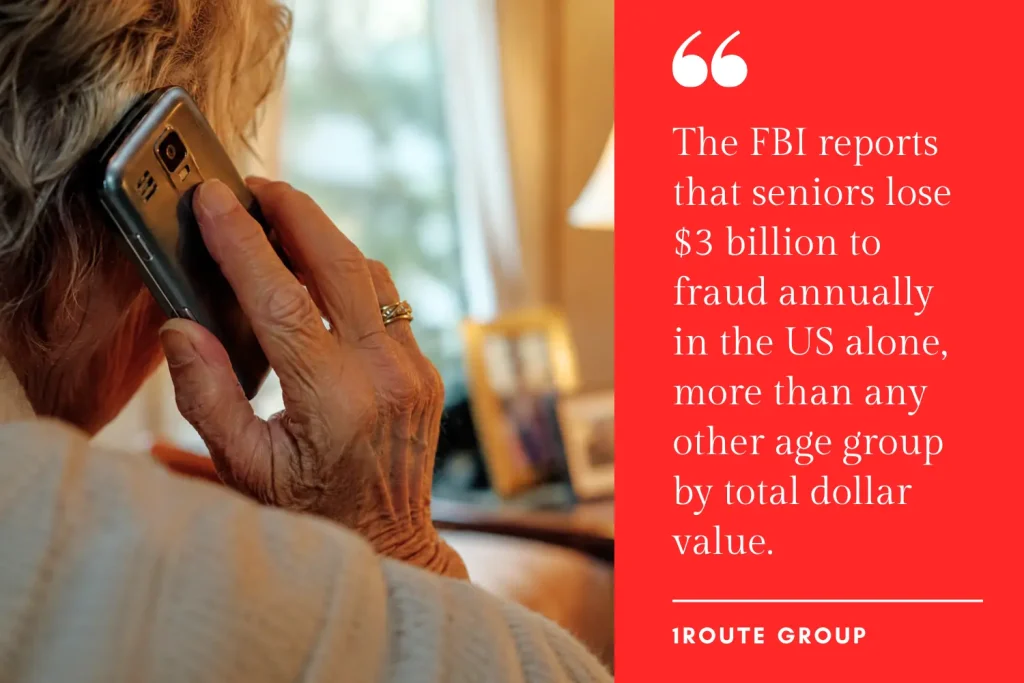
The Attig case is not an outlier. The FBI reports that seniors lose $3 billion to fraud annually in the United States alone, more than any other age group by total dollar value. What makes elderly consumers particularly vulnerable is not naivety, but trust. They grew up in an era when a voice on the phone was sufficient verification. Fraudsters know this and engineer their attacks accordingly.
At the network layer, what enables these attacks is the breakdown of call authentication. Verified call scams work precisely because the systems designed to flag suspicious calls (such as STIR/SHAKEN attestation frameworks and caller ID validation) were built to protect carriers from revenue loss, not consumers from manipulation. A call can pass every technical checkpoint and still be a weapon.
The gap between what networks can verify and what people actually experience is where the real damage happens. Closing it requires fraud detection that operates before a call ever reaches a subscriber—at the point of entry, not after.
One Call. One Million Dollars Gone.
At 5:05 p.m. on March 7, 2025, Jim Dunworth received an email from Broadway Bank warning him of suspicious activity on his accounts. But by then, the damage was already moving.
Dunworth is the owner of Jim Dunworth Inc., a car dealership in San Antonio. What hit him was not a lucky guess or a crude phishing attempt. Fraudsters, armed with specific details about his business, called Broadway Bank while impersonating him and his employees. They knew enough to be convincing. They initiated transfers. Nearly $1 million was gone before anyone caught it.
One detail stood out in the investigation: the fraudsters had learned from a podcast that Dunworth’s business was relocating to Florida. That single piece of public information became the pretext that made their impersonation plausible. Broadway Bank initially pushed liability back to Dunworth, a response that has become depressingly common in cases involving small businesses.
Spoofed calls and social engineering are not separate threats. One creates the conditions for the other.
Why Small Businesses Are the Perfect Target
There is an old saying in security circles: attackers go where the defenses aren’t. Small and medium-sized businesses sit in a particularly exposed position. They generate enough revenue to make fraud worthwhile, but they rarely have the security infrastructure of a large enterprise. Most do not have dedicated fraud teams. Many are one phone call away from a catastrophic loss.
Between 2021 and 2023, the CFCA documented a 12% increase in global fraud losses, with SMEs increasingly in the crosshairs. Unlike larger carriers or corporations, most small businesses cannot absorb a six-figure loss. When fraud hits at that scale, it does not just threaten the bottom line. It threatens livelihoods, payroll, and years of built-up trust with customers and banks alike.
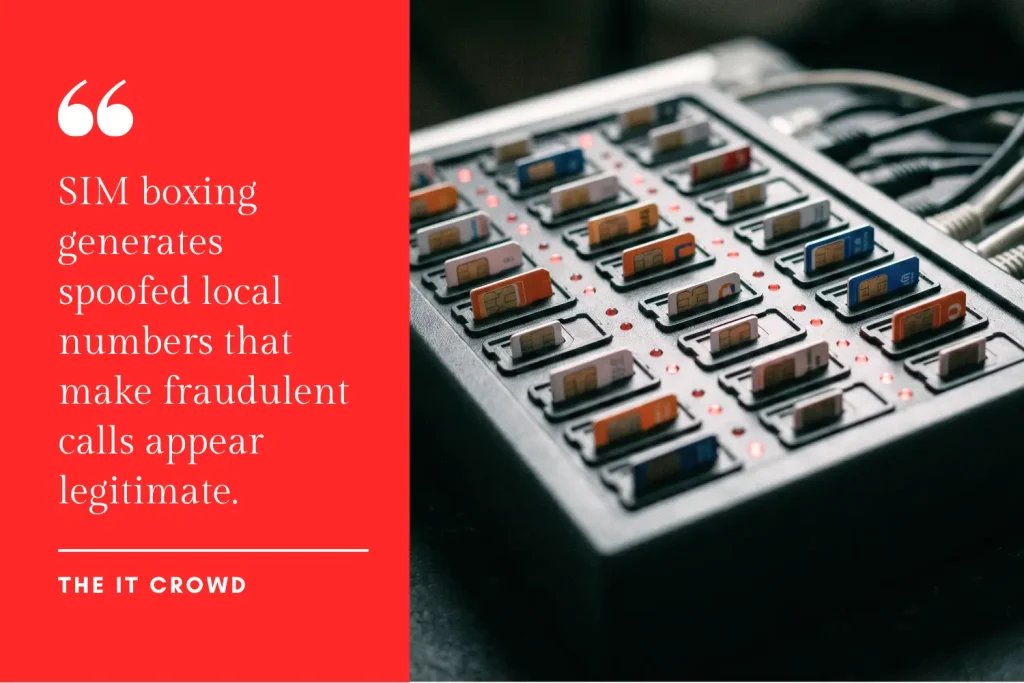
SIM boxing plays an enabling role here that rarely gets discussed in consumer-facing coverage. By routing international calls through local SIM cards to avoid interconnect fees, SIM box operators generate spoofed local numbers that make fraudulent calls appear legitimate. The caller ID on Dunworth’s bank’s screen may have looked exactly like a number it should trust. That is not an accident. That is artificially inflated traffic fraud working exactly as designed.
A Government Scheme, a Fake File, a Life’s Work Gone
Mokam Singh is a transporter based in Kanpur, India. In August 2025, he received a WhatsApp message that appeared to be from an official government source, a notification about the PM Kisan Yojna scheme formatted like an RTO Challan. He clicked the link. The file installed itself silently on his phone.
What followed was a precisely coordinated attack. Criminals used the malware to execute an unauthorized SIM swap on Singh’s mobile number. With his number under their control, they bypassed two-factor authentication on his bank accounts and withdrew Rs 1,27,85,779 (approximately $144,000 USD) in a single day. With part of the proceeds, the accused purchased nearly Rs 55 lakh worth of gold before police tracked him down in Meerut.
Singh had done nothing wrong. He clicked what looked like an official government document, on a platform millions of Indians use daily. The attack succeeded because it was designed for exactly the environment he lived in.
Mobile identity theft through SIM swap is not a fringe threat. South Africa loses R5.8 billion annually to telecommunications fraud, with 40% driven by mobile banking fraud. The country’s RICA Act, which governs SIM card registration, has been widely criticized for structural weaknesses that make consumers easier to impersonate than to protect. Biometric checks during a SIM swap can authenticate against the fraudster’s face rather than the legitimate account holder’s.
The Infrastructure Gap No One Talks About
Pull back and the pattern becomes structural. Fraud does not distribute evenly. It concentrates where detection is weakest, where regulation lags, and where victims have the least institutional recourse. Elderly consumers, small business owners, and mobile-first users in high-growth markets are not random victims. They are the predictable result of a global network built for connectivity first and trust second.
International revenue share fraud bleeds the carriers that can least afford it. SIM boxing siphons interconnect fees from operators across Africa, APAC, and EMEA, degrading the infrastructure investment that would otherwise improve service for everyday users. The money that funds these operations flows, according to the ITW Global Leaders’ Forum, into criminal ecosystems that include organized crime and terrorist financing networks.
Fraud against a network has never been a victimless crime. It just takes a few steps to find the victim.
Bringing Trust Back to Voice
Three people. Three continents. Three completely different fraud types. One throughline: all of them were reached through a communication channel they had every reason to trust, and none of them had meaningful protection at the moment it mattered.
The industry has always known how to count fraud. It is only beginning to understand who pays for it.
What Judy Attig needed was a network that could verify whether the call she received was legitimate before it connected. What Jim Dunworth needed was a system that could detect the spoofed calls being used to impersonate him at his own bank. What Mokam Singh needed was a SIM that could not be swapped without his knowledge, regardless of what documents a fraudster presented at a store counter.
This is what 1Route was built to address. Operating across Africa, EMEA, and APAC, 1Route’s three-pillar defense works at every layer where fraud enters:
- EDGE Computing Solution validates inbound traffic at network ingress, blocking fraudulent calls before they connect
- FINIS Platform acts as a firewall in the core signaling layer, intercepting SIM boxing, international revenue share fraud, and artificially inflated traffic in real time
- On-SIM Protection secures subscriber identity at the device level, preventing SIM swap attacks before they reach a bank account or a 2FA verification code
The telecom industry is very good at counting what fraud costs. 1Route is focused on stopping it. One call, one SIM, one subscriber at a time.
If your network is still measuring fraud after it happens, it may be time to explore what stopping it before it connects actually looks like. See 1Route’s fraud prevention solutions.
Frequently Asked Questions
What is the human impact of telecom fraud beyond financial loss?
Beyond lost money, victims of telecom fraud report lasting anxiety, eroded trust in communications, and in elderly cases, shame that discourages reporting. Small business owners also face reputational damage that can outlast the financial recovery.
Which populations are most vulnerable to telecom fraud in 2026?
Elderly consumers, small business owners, and mobile-first users in emerging markets face the greatest risk. Seniors lose $3 billion annually to fraud in the US alone. SMEs lack enterprise-grade defenses. And consumers in Africa, South Asia, and APAC are acutely exposed to SIM swap and mobile identity theft.
How does SIM boxing affect ordinary consumers, not just carriers?
SIM box fraud generates spoofed local numbers used to make scam calls appear legitimate, directly enabling attacks on consumers and businesses. It also drains carrier revenues that would otherwise fund network infrastructure, raising costs and degrading service for everyday users.
What is two-factor authentication (2FA) interception and why is it dangerous?
2FA interception happens when a fraudster takes over a victim’s phone number via SIM swap and uses it to receive one-time passcodes. This bypasses account security on banking and mobile money apps, often emptying accounts before the victim realizes anything is wrong.
What makes 1Route’s approach to telecom fraud prevention different?
Most solutions analyze fraud after calls connect. 1Route intervenes earlier, at network ingress (EDGE Computing Solution), the core signaling layer (FINIS Platform), and the subscriber’s device (On-SIM Protection), blocking fraud before it reaches anyone. 1Route also specializes in Africa, EMEA, and APAC, where fraud hits hardest.
How can carriers and enterprises take action against telecom fraud today?
Start by identifying where your current defenses stop. If fraud detection relies on post-call analytics, there is a gap at network ingress. 1Route offers multi-layer protection across signaling, ingress, and device endpoints for carriers in high-risk markets. Contact 1Route to start the conversation.
